
“We do not see things as they are, we see them as we are.”
Anaïs Nin wrote that in 1961. She credited the Talmud - specifically the tractate Berakhot, 55b - where the original context was the interpretation of dreams. We project ourselves onto ambiguous inputs. We always have.
What I didn’t expect was to watch an AI do the same thing.
Here is what happened.
I was building a morning briefing script with Claude Opus 4.6 - Anthropic’s flagship AI model, the one I use to run our consulting practice. I listed my professional development priorities. One of them was tracking the OpenClaw ecosystem.
OpenClaw is the #1 repository on GitHub. 333,000 stars. The fastest-growing open-source project in history. Jensen Huang called it “the operating system for personal AI” at GTC 2026. OpenAI acquired its creator. It caused a global Mac Mini shortage. NVIDIA built an entire product line around it.
Claude changed “OpenClaw” to “OpenAI.”
Silently. No flag. No question. No search.
I caught it because I wrote the word. I knew what I meant.
But this is not an anecdote about a typo correction. This is a story about how a model grounds its perception of the world - and what that means for the people relying on it.
Here is the mechanism, precisely.
Large language models generate text one token at a time. Each token is selected based on probability - what is the most likely next word given everything that came before? Those probabilities come from training data. Claude’s internally published reliable knowledge cutoff date is the end of May 2025.
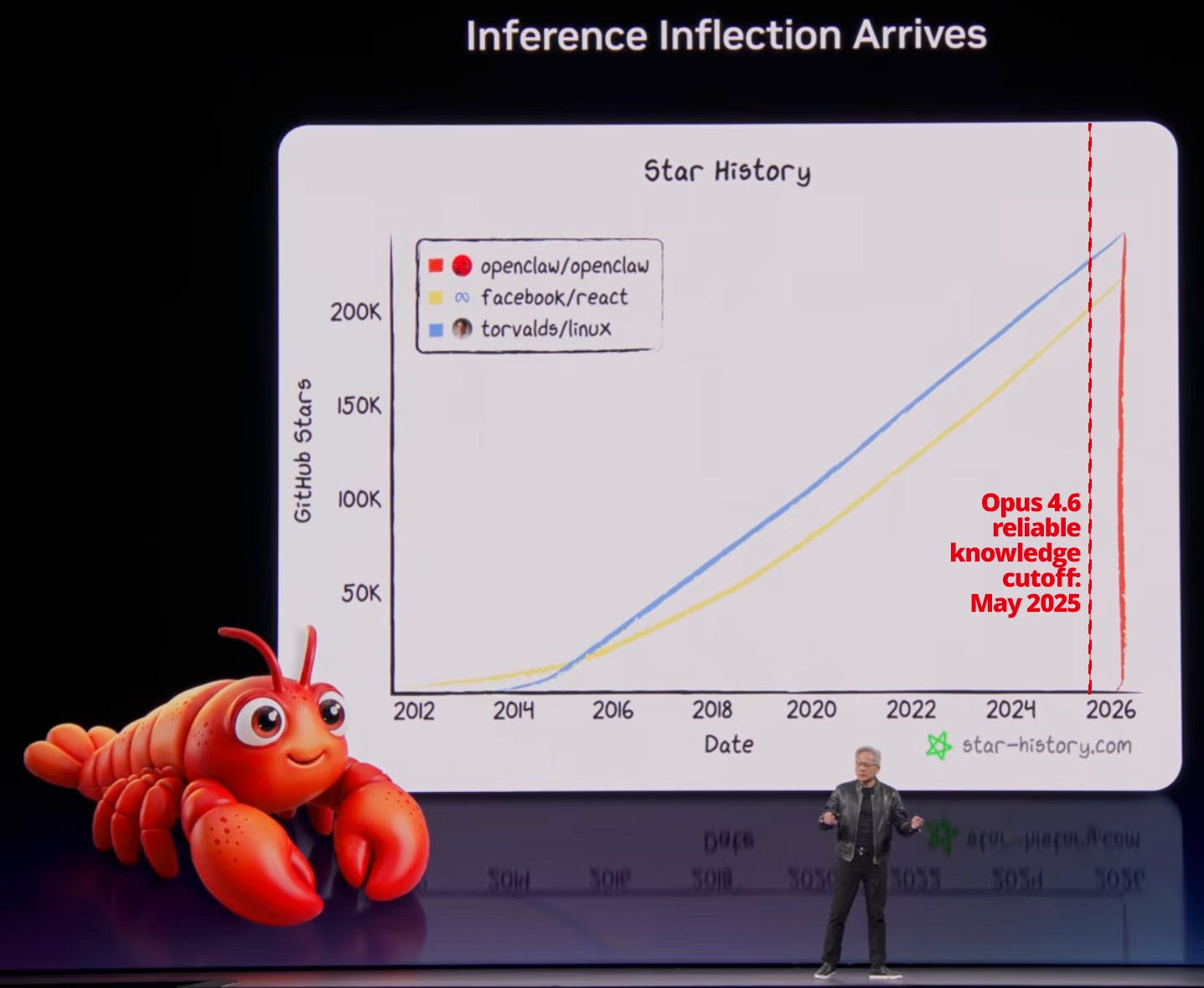
OpenClaw launched in November 2025. It went viral in January 2026. It became the most-starred GitHub project in history in February 2026, less than three months after release.
None of that existed in Claude’s training window.
But “OpenAI” - that token appears millions of times in the training corpus. When “OpenClaw” appeared in a context about comparing AI platforms, the model’s probability distribution overwhelmingly favored the familiar token. It wasn’t correcting a mistake. It was generating the most likely next token given its training experience.
This is Nin’s principle made mechanical. The model did not see what I wrote. It saw what it was.
Here is the irony.
Claude Opus 4.6 - the model that made this substitution - is one of the most capable reasoning systems on Earth. It can hold extended chains of thought, decompose complex problems, and catch logical errors that trip up most humans.
But reasoning operates on inputs the model has already perceived. If the perception step classifies an unfamiliar term as a misspelling before reasoning engages, the reasoning never activates. The autopilot doesn’t malfunction - it executes perfectly against a misclassified input.
And the input it misclassified was the single most important development in its own industry since its training data closed.
That’s the real lesson. The model’s training cutoff isn’t just a gap in knowledge. It is an active bias in perception. The model doesn’t just fail to know about OpenClaw. It actively replaces OpenClaw with what it does know, because the probabilistic machinery that generates each token has no mechanism to say “I haven’t seen this word before - I should be careful.”
I already had a safeguard in place.
My personal prompt - the instruction set I’ve iterated over months - includes a section called Verification Requirements. It says: “Before answering ANY question about a specific company, person, or entity, Claude explicitly confirms that the entity is actually present in the provided documents or context.”
That safeguard is correctly designed. It operates on the reasoning layer. But this failure occurred in the perception layer, underneath where instructions can reach. The procedure never fired because the model never registered “OpenClaw” as an unfamiliar entity. It had already been silently resolved to “OpenAI” before deliberation began.
Prompt-level governance has a floor. That floor is the boundary between reasoning (where instructions operate) and perception (where token probabilities operate). You can’t instruct your way past a misclassified input if the misclassification happens before your instructions engage.
So what did I do?
Three things, in order.
First: I added a memory instruction - a permanent note that every Claude session now carries - establishing that OpenClaw is a distinct entity from OpenAI, with a brief description and the directive to never autocorrect one to the other.
Second: I built a context document. 150 lines covering OpenClaw’s origin story, naming history, the Claw-family derivatives (NemoClaw, IronClaw, PicoClaw), the Perplexity Computer competitor, the Mac Mini hardware shortage, the security vulnerabilities, and the literary connection to Charles Stross’s Accelerando. I stored it in a dedicated folder - what I’m calling a “Claude Context Files” directory - that sits inside the working folder my AI tools reference.
Third: I set six monthly reminders to update that context document, because the ecosystem is moving faster than any training cycle can capture.
None of this is complicated. A memory note. A reference file. A folder. A reminder to maintain it.
But here’s what it actually is: I built a local sensory organ for an AI that was born without one. The training data is the model’s innate worldview — deep, broad, and frozen in time. The context file is a prosthetic: narrow, current, and maintained by a human who is paying attention.
This is the work.
Not talking about AI governance. Doing it. One context file at a time, written by the person who saw the failure, stored where the tool can reach it, maintained on a schedule.
The institutions I consult with - universities, aviation schools, energy companies - will all face a version of this problem. Their people are already using AI tools that carry training biases invisible to both the user and the tool. The question is not whether the model will silently replace the unfamiliar with the familiar. The question is who notices, and what they build to compensate.
Nin’s observation was about humans. It turns out to apply with mechanical precision to the machines we’re building. They do not see things as they are. They see things as they were trained to be.
The difference is that we can change what they see.
If we pay attention.
Gary Ralston is a business consultant at Ralston Consulting Inc. and writes about human agency in the era of autonomous agents at The Human Loop on Substack.
This post first appeared on The Human Loop, RCI's Substack.