
By Diego Soroa (diegosoroa.com)
For presidents and cabinets of AFIT member colleges.
In three days, NorthWest Arkansas Community College (NWACC) drafted an AI vision, had it challenged by 220+ of its own students and faculty, and left with owned 30-day experiments across the institution.
This brief shows how, and what it would take at your college.
The problem
AI is reaching your classrooms and offices faster than any policy can keep up. Some faculty have used it for years; others want no part of it. Employers in your region are already asking what your graduates can do with it.
The usual responses are a task force, a policy memo or a one-off keynote. They produce documents, not movement. What most colleges lack is not a strategy but a safe way for faculty and staff to try things, learn in public and keep what works, while improving student relations and readiness.
The approach: three days, one system
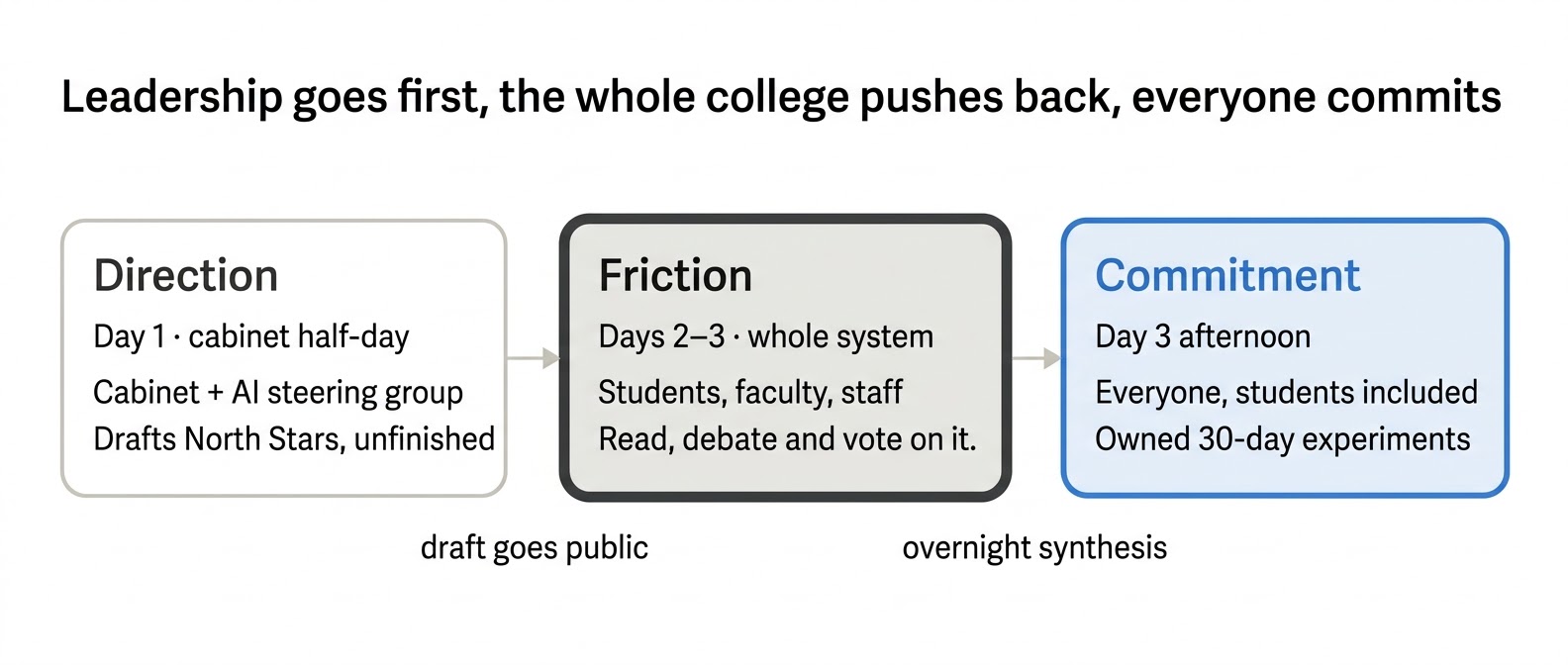
The three-day arc · Direction, Friction, Commitment
Four design choices make it work:
- Leadership goes first, and goes unfinished. A draft invites challenge; a policy invites compliance.
- Friction is designed in. Students are asked for disagreement, not feedback: “You don’t just have our permission to disagree. You have our request.”
- Overnight synthesis. The gap between leadership’s reading and the students’ becomes the next morning’s decision material, while the room is still warm.
- It ends in ownership, not a report. Everyone leaves with one experiment, one owner and one date.
The evidence: NWACC, autumn 2026
Wednesday: leadership went first, and went unfinished.
In a closed half-day, the cabinet and AI steering group drafted five North Stars for the college under one principle: whatever AI does here, a specific person is always in charge of the learning. They carried it into Thursday as a draft, not a policy.
Thursday: students pushed back.
About 220 students and faculty read the draft at their tables and reported what they saw. Where leadership saw help, students often saw a barrier. To make the college more accessible, the draft promised every student a personal AI coach, from recruitment to graduation. Students answered that access means a person who answers: a call returned, an office that picks up. Their verdict: “fix the phones before building a coach.” They also noticed who was missing. Online students, a large share of enrollment, were not in the draft at all.
That afternoon the room debated three motions in Oxford style, the format of the Oxford Union: the room votes on a motion, speakers argue for and against it, and the room votes again. The gap between the two votes shows how many minds the arguments changed. Each debate ran about 40 minutes, with 41 to 58 voters per round:
| Motion | What moved |
|---|---|
| AI will hollow out entry-level careers | Support fell from 57% to 39%; the room ended evenly split |
| The college should teach with AI in every course by 2027 | Support held at 25%; opposition grew, mostly over the word “every” |
| AI should be granted legal personhood | Near-unanimous rejection softened into doubt |
Friday: everyone committed.
In the morning, faculty and staff turned the gaps students had found into teaching redesign. In the afternoon, the cabinet, faculty, staff and student government each left with a named 30-day experiment, an owner and a date.
“What has helped us students build confidence… it isn’t AI. It’s student organizations. It’s community.”
Student
The big unlock: a sandbox with low stakes and reversibility
The most transferable result is not the vision. It is the operating model for experimenting safely, built live with the college’s own staff:
- Two-way doors. Small, reversible experiments with no student data need no approval, just a heads-up.
- A green list of approved tools anyone can use without asking.
- Owner plus sponsor. One named person runs it, one leader protects it. Never a committee.
- Kill criteria on day one. Ending an experiment is a result, not an embarrassment.
- Show the work. A monthly show-and-tell where failures count as findings.
- The time dividend. Time saved by AI goes back to people, not to cost cuts.
- A slow lane on purpose. Grades, student data, accommodations, safety and people’s jobs never move fast.
Every experiment passes five tests:
- Small,
- Reversible,
- Owned,
- Observable,
- Linked to a North Star.
An example from the room: for 30 days, financial aid uses AI to draft first replies to its five most common emails; the time saved goes to returning every voicemail within 24 hours; the measure is callback time.
Diego’s insight and guidance were both timely and relevant as we further explored how AI will reshape the learning experiences and the daily operations of our college.
Through the sessions with him, NWACC leadership, faculty, staff and students contributed to the development of our north stars, which we are incorporating into the college’s strategic plan.
Thanks to Diego, participants engaged in passionate and honest conversations. We came away with a better understanding of both the challenges and the opportunities ahead, and what we will need to do to best serve our students in this season of rapid transformation and discovery.
Dennis C. Rittle, PhD, MBA
President, NorthWest Arkansas Community College
What your college leaves with
Nothing in this format depends on one campus. The same three-day arc can run at your college, adapted to your calendar, your people and the questions they are already asking.
One speaker / facilitator carries a single narrative thread through all of it, about 15 hours of delivery. An overnight synthesis turns each day’s disagreement into the next day’s decision material.
Each element below builds on the one before it, so it works as a whole rather than a menu.
| Element | Who is in the room | What you leave with |
|---|---|---|
| Voice harvest (before) | All students, faculty and staff, online | What your people hope for, fear and want protected |
| Cabinet half-day | President, cabinet, AI steering group | A one-page draft of North Stars and invariants, deliberately unfinished |
| Whole-system day | Students, faculty, staff together | Readings of each North Star, debated and voted in public |
| Faculty and staff day | Faculty and staff | Teaching redesign and the sandbox rules for your campus |
| Commitment session | The whole system, students included | Named 30-day experiments, each with an owner and a North Star |
| 30-day check-in | Leadership and experiment owners | What worked, what to stop, what to scale |
Three next steps
- Reach out. A 45-minute call with your president. You leave with a one-page diagnostic of where your college stands.
- Commit the time. Put the package above in the calendar: a cabinet half-day, a whole-system day, a faculty and staff day, a commitment session and a 30-day check-in.
- Convene the whole system. Having students in the room is not optional. The friction is the product.
Who we are.
Diego Soroa is Founder and Head of the IE Edge Lab for Radical Thinking and Disruptive Innovation at IE University in Madrid, and has led more than 75 enterprise transformations. AFIT members may know him from the 2026 Summer Institute. Ralston Consulting Inc. is the US partner for every engagement.
Contact:
Diego Soroa, IE University — keynote@diegosoroa.com
Gary Ralston, Ralston Consulting Inc. — gary@ralstonconsulting.com
We wish to thank the Alliance for Innovation and Transformation (AFIT) for connecting us with their members.
This post also appears on The Human Loop, RCI's Substack.